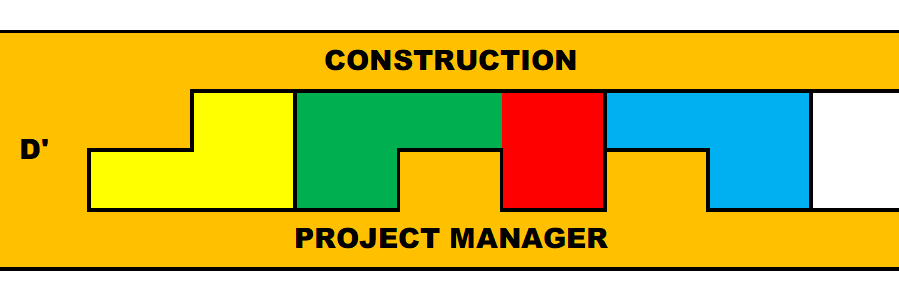
In construction project delivery, selecting the right contracting strategy can significantly influence cost, schedule, risk, and overall project success. Two commonly used approaches are the Multiple Prime Strategy and the General Contractor (GenCon) Strategy. While both aim to deliver a completed project, they differ fundamentally in structure, responsibility, and risk allocation.
Understanding the Two Strategies
1. Multiple Prime Strategy
In a Multiple Prime setup, the project owner directly contracts with several specialized contractors—typically one for each major trade (e.g., civil works, structural, electrical, mechanical).
- The owner manages multiple contracts
- Each contractor is responsible for their specific scope
- Coordination between contractors often falls on the owner or a hired construction manager
The owner is at the center of the web, directly dealing with each contractor.
2. General Contractor (GenCon) Strategy
In a General Contractor setup, the owner signs one contract with a single general contractor. The general contractor then hires and manages all subcontractors.
- The general contractor assumes overall responsibility
- Subcontractors report to the general contractor, not the owner
- Coordination, scheduling, and site management are handled by the GenCon
The general contractor acts as the central hub, simplifying the owner’s involvement.
Key Differences at a Glance
| Aspect | Multiple Prime | General Contractor |
|---|---|---|
| Contracts | Multiple (owner to each trade) | Single (owner to GenCon) |
| Coordination | Owner or CM manages | GenCon manages |
| Risk Exposure | Higher for owner | Lower for owner |
| Control | High owner control | Delegated control |
| Flexibility | More flexibility in trade selection | Less direct control over subs |
| Administrative Load | Heavy on owner | Reduced for owner |
When to Use Each Strategy
Multiple Prime Works Best When:
- The owner has strong technical expertise
- There is a desire for direct control over trade contractors
- Cost transparency is a priority
- The project is less complex in coordination
GenCon Works Best When:
- The owner prefers a single point of accountability
- The project involves complex coordination
- Time efficiency is critical
- The owner wants to minimize management burden and risk
Orchestra vs. Band Manager
Think of a construction project like a musical performance:
- Multiple Prime Strategy is like an orchestra where the composer (owner) directly manages each musician—violinists, drummers, pianists. While this gives full control, the composer must ensure everyone plays in sync. If something goes wrong, the responsibility is theirs.
- General Contractor Strategy is like hiring a band manager. The composer only deals with the manager, who then organizes all musicians, rehearsals, and performance. The composer focuses on the vision, while the manager ensures execution.
Advantages and Trade-offs
Multiple Prime
Pros:
- Greater control over each contractor
- Potential cost savings (no GenCon markup)
- Direct communication
Cons:
- Increased coordination complexity
- Higher risk of disputes between contractors
- Heavy administrative responsibility
General Contractor
Pros:
- Single point of responsibility
- Simplified communication
- Better coordination and scheduling
Cons:
- Additional cost (overhead and profit)
- Less direct control over subcontractors
- Potential for reduced transparency
The choice between Multiple Prime and General Contractor strategies comes down to a balance between control and convenience:
- If you want maximum control and cost transparency, and you have the capability to manage complexity, Multiple Prime may be suitable.
- If you prefer simplicity, reduced risk, and streamlined execution, a General Contractor is often the better choice.
Ultimately, the right strategy depends on the owner’s experience, project complexity, and appetite for risk. Choosing wisely at the outset can make the difference between a well-orchestrated project and a chaotic one.