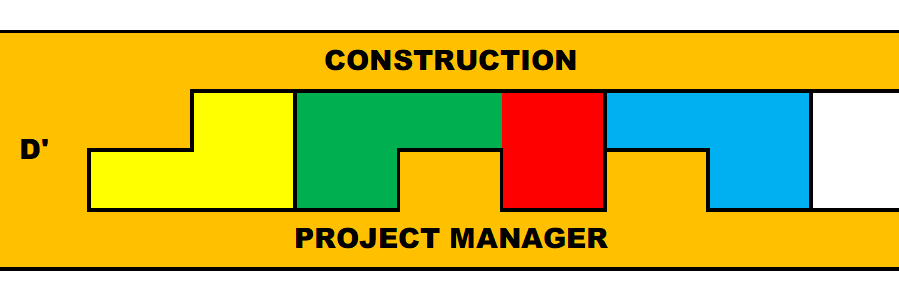
Selecting the right procurement and contracting strategy is one of the most critical decisions a project owner makes. It determines not only who carries the risk, but also how smoothly the project runs, how transparent the costs are, and how much control the owner retains.
This article breaks down four widely used approaches:
- General Contractor (GenCon)
- Multiple Prime
- Main Contractor (for Multiple Prime Coordination)
- Main Contractor with Nominated Subcontractors
General Contractor (GenCon)
The owner hires one contractor responsible for the entire project, including all subcontractors.
Key Characteristics
- Single contract
- Full responsibility lies with the contractor
- Subcontractors are managed internally
Pros and Cons
| Pros | Cons |
|---|---|
| Single point of accountability | Less cost transparency |
| Minimal owner coordination | Higher overall cost (markup layers) |
| Faster decision-making | Limited control over subcontractors |
| Lower owner risk exposure | Contractor may price in risk premiums |
Multiple Prime Strategy
The owner directly contracts separate trade contractors (e.g., structural, MEP, architectural works).
Key Characteristics
- Multiple contracts
- Owner acts as central coordinator (or appoints one)
- Trade contractors work in parallel
Pros and Cons
| Pros | Cons |
|---|---|
| High cost transparency | High coordination complexity |
| Potential cost savings | Owner bears schedule/interface risk |
| Direct control over contractor selection | Increased administrative burden |
| Flexibility in procurement | Higher likelihood of disputes |
Main Contractor (for Multiple Prime Coordination)
A hybrid approach where a Main Contractor is engaged mainly to coordinate multiple prime contractors, not to fully absorb all risks like a GenCon.
Key Characteristics
- Multiple trade contracts still exist
- MainCon acts as coordinator/manager
- Risk is shared
Pros and Cons
| Pros | Cons |
|---|---|
| Reduces owner coordination burden | Blurred lines of responsibility |
| Better integration than pure multiple prime | Not full risk transfer |
| Retains some cost transparency | Additional coordination cost |
| Improves scheduling control | Potential scope gaps between trades |
Main Contractor with Nominated Subcontractors
The owner selects specific subcontractors (usually for specialized systems), but the Main Contractor remains contractually responsible for delivering the project.
Key Characteristics
- MainCon holds the main contract
- Owner nominates key subcontractors
- Shared influence over execution
Pros and Cons
| Pros | Cons |
|---|---|
| Owner control over critical trades | Split accountability risks |
| Access to preferred specialists | Possible delay disputes |
| Balanced control and management | MainCon may resist responsibility for nominated parties |
| Maintains structured coordination | Reduced flexibility for MainCon |
Comparative Overview Table
| Criteria | GenCon | Multiple Prime | MainCon (MP Coord.) | MainCon + Nominated Subs |
|---|---|---|---|---|
| Contracts | Single | Multiple | Multiple + Coordinator | Single + Nominated |
| Coordination Responsibility | Contractor | Owner | Shared (MainCon-led) | MainCon |
| Cost Transparency | Low | High | Medium | Medium |
| Owner Control | Low | High | Medium | High (targeted) |
| Risk to Owner | Low | High | Medium | Medium |
| Speed of Execution | High | Variable | Medium | Medium |
| Dispute Potential | Low | High | Medium | High |
| Best For | Simplicity & speed | Cost control & flexibility | Balanced approach | Specialized systems control |
Building Your Dream Home
Think of these strategies like organizing the construction of your dream home:
- GenCon
You hire a turnkey builder who handles everything—from design coordination to construction. You just monitor progress. - Multiple Prime
You personally hire the architect, electrician, plumber, and carpenter, and you manage all of them yourself. - MainCon (MP Coordination)
You still hire all specialists directly, but you appoint a site manager to coordinate their work and schedule. - MainCon + Nominated Subcontractors
You hire a builder, but you insist on choosing your own electrician and kitchen specialist, while the builder manages everything else.
Each approach reflects a different balance between control, effort, and risk.
Choosing the right strategy depends on what matters most to the owner:
- If you want simplicity and minimal risk → go for GenCon
- If you want maximum control and cost transparency → choose Multiple Prime
- If you want a middle ground with coordination support → consider MainCon (MP coordination)
- If you want control over key trades but still need structure → opt for MainCon with Nominated Subcontractors
Final Insight
There is no universally “best” method. The optimal choice depends on:
- The owner’s technical capability
- The project’s complexity
- The desired level of control vs. risk transfer
A well-informed strategy at the start can prevent costly issues later in the project lifecycle.